Food Defense

  • Featured Article Order: 1

The Food Safety Modernization Act (FSMA) has created a mandate for food manufacturers to safeguard against the deliberate contamination of food. While protection methods against intentional adulteration of food are not yet well defined by the FSMA, some basic principles should  be utilized to limit food plants vulnerability to intentional acts.

Securing the perimeter of the site of a food plant is a first step in control. Limiting the access to the site through monitored entry points where persons entering the facility must check in before gaining access to the property will limit exposure. Fencing and other security barriers can be employed to control  access to the site. In addition, all exterior doors should have limited access using a keycard system.

Security cameras and other surveillance systems may be used both outside and inside the facility to monitor activities in critical areas. However, surveillance systems can also have a detrimental effect on the mindset of well-intended employees who may feel violated by being continuously monitored. In addition, if a video surveillance system is not continually monitored, it will only function as a reactive system documenting egregious acts.

Training employees to be vigilant in spotting possible violations can also be an effective measure in preventing intentional adulteration. A workforce that is alert to suspicious or unusual activity provides real-time monitoring of food production operations.  In addition, background checks and vetting of employee work history before bringing in new hires can help lessen  potential issues created from internal staff.

Security efforts should also focus on the most vulnerable aspect of a food plant’s production operation. Though the vulnerability of each operation is site specific,  here are some common areas on which to focus:

Receiving/Shipping Areas: Places where liquid and dry bulk ingredients and products are both received and shipped

Storage and Warehouse Areas: Silos and storage containers where bulk ingredients are stored, including liquid, dry, and solid ingredients

Ingredient Mix and Preparation Areas:Locations where the blending of dry and liquid ingredients is preformed

Mixing, Blending, Grinding Areas:Locations  where the product is being reformed and/or combined with other products or ingredients

The ability to implement a solid food defense system is greatly influenced by the layout and design of the plant. Access to the site depends on the location of entry points. The system for monitoring visitors entering the building depends on the location of shipping/receiving, offices, and maintenance. Finally, securing critical storage and processing rooms from nefarious activity depends on internal accessibly to these areas.
Food Safety Scorecard

  • Featured Article Order: 1

What factors are important for producing safe products in a plant environment?

We are constantly asked this question! To give you answers, Foth | Food Plant Engineering has developed a scorecard for evaluating good manufacturing practices (GMPs) and facility design concepts. This practical guide will help you answer this and other questions about your facility.

The Challenge

Few plants were constructed yesterday. In fact, most food plants have grown in a fashion that does not create an optimal environment for food safety. When it comes time to upgrade and add to your facility, how do you incorporate the latest food safety ideas and GMPs into the plans?

This is a challenge for existing facilities, and one we face with every expansion/renovation project we undertake.

Click on this link (Food Safety Scorecard) to download a scorecard to measure your plant's food safety score. Every plant and process is different, so keep in mind that the purpose of the scorecard is to help foster thinking about food-safety ideas and concepts.

Read on to learn more about how apply this scorecard to what we call the Hygienic Core concept.

Where to start: The Hygienic Core

The Hygienic Core is the area (or areas) in your plant where everything comes together before it goes out the door. You can identify your Hygienic Core by defining the space where your product is last exposed before it is sealed in its final packaging. This area is an epicenter of food safety. Thus, everything traveling in and out of this zone must be controlled to eliminate food-safety hazards. All food-safety strategies must radiate from these hygienic cores.

To achieve this Hygienic Core, you must first control the flow of everything that enters this space. By "everything," we mean people, product, supplies, ingredients, packaging materials, spare parts, pallets, airflow, etc.

Personnel access to this area should be controlled and restricted. To achieve such control you may need a gowning room with timed hand wash and boot wash stations. You can set this up so that access into the plant is permitted only after a predetermined wash time has elapsed.

The airflow to the Hygienic Core must also be carefully controlled. In some cases, this may require a dedicated air handler with high levels of filtration. If the room is refrigerated, the unit should utilize outside air and HEPA filtration to supply highly-filtered air into the Hygienic Core. In all cases, the air handling system should create a pressurized space in this area. The pressurized air from the Hygienic Core then radiates outward toward the less critical processing areas.

Materials entering the room should be controlled as well. This may mean installing "pass-thru" or conveyors to deliver supplies to the space without entering the room.

These are just some of the concepts that are needed to create a Hygienic Core. Please review the Food Safety Scorecard for more ideas. When applying the concepts, remember that your food-safety system begins at the Hygienic Core and works its way outward from there.

How We Can Help

Tackling a facility project of any kind, whether it's new construction or a renovation, is complicated business when food is involved. Plan carefully and rely only on a firm with extensive experience in the food industry to get the job done right.

Foth | Food Plant Engineering has been successfully designing food facilities for more than 70 years. Let us help you protect your future.

Preventing Condensation in Food Plants

  • Featured Article Order: 1

Condensation: Solving the Problem

Bring out the mop patrol; the pipes are sweating and puddles have formed on the floor. If this sounds like your plant, read further for condensation solutions.

Condensation occurs when the surface temperature of a material in your plant is below the dew-point temperature of the air in contact with the material. The air (vapor) that causes condensation can enter a room in many different manners, disrupting the atmospheric balance of the entire area.

Vapor can penetrate the ceilings and walls through pinhole-size openings (vapor barrier problem), or it can be drawn in by the flow of air into the room through openings such as doors (ventilation problem). Vapor can also originate from production equipment or when the product itself gives off moisture (humidity problem).

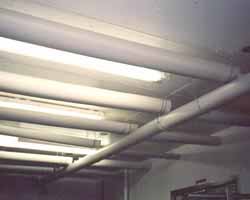
Does this look familiar? These "gutters" were hung below the ceiling to capture the condensation from pinhole size vapor leaks in the ceiling panels.

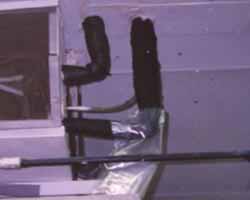
Improper pipe penetrations through a ceiling allow vapor to condense at the bottom of the pipe. (See the plastic to capture the drips.) Vapor can travel inside a pipe jacket/insulation from above the ceiling and enter the room if not properly sealed.

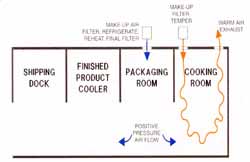
Proper air balance prevents unwanted humidity from entering a room. In this illustration, warm moist air from the cooking room is prevented from entering the packaging room.

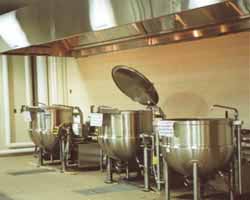
Hoods above these kettles help contain vapor migration. Care must be taken to have proper hood design to capture the vapor and eliminate roll-out.

Vapor Barrier Problem

A problem with a room's vapor barrier exists when condensation occurs through pinhole-size openings in a room's envelope (walls and ceilings). If a hole exists in a vapor barrier, any vapor pressure difference between the inside and the outside forces vapor through the hole. This differential vapor pressure can be significant, especially in the summer months.

For example, when:

1. The outside conditions are 90-degrees F with 50% relative humidity; the vapor pressure equals 0.75 inches Hg.

2. The inside conditions are 45-degrees F with 85% relative humidity; the vapor pressure equals 0.25 inches Hg.

Thus, the vapor pressure difference from the outside to the inside is 0.50 inches Hg. This pressure is equal to 6.8 inches of water standing on a ceiling in the room!

Solution: Seal these holes so vapor does not enter the room, thus preventing condensation when the vapor reaches the cold space.

The holes must be sealed on the warm side (the vapor barrier side) with a true vapor barrier product.

Another solution to reduce the effect of vapor leaks in the ceiling (assuming the holes cannot be sealed properly) is to reduce the vapor pressure above the ceiling.

Installing air conditioning or dehumidification equipment above the ceiling lowers the vapor pressure differential, which helps reduce the effective differential, but it does not change the fact that holes still exist in the vapor barrier. This "solution" simply slows the rate of vapor passing through the holes.

Ventilation Problem

Condensation can occur when humid air is drawn into a room through openings (such as doors), and condenses when it reaches the colder room. This condensation can form as moisture on the walls and ceiling, or as fog in the room.

Solution: Prevent air from entering the room in an uncontrolled manner. In order to accomplish this, the air flow in the entire facility must be accounted for by investigating the air flow balance. Many times, the air flow in the problem room alone is investigated. However, each point of exhaust and supply from the facility must be accounted for to ensure that the building is in proper balance.

Each area within the facility must also be evaluated to determine the desired air flows between adjacent spaces. The determination of where the air should be flowing within the spaces depends on the food-safety objectives as well as other considerations.

Humidity Problem

Condensation can occur when moisture is produced in the room by equipment or open-product cooling. The moisture evaporated from the product or released by the process raises the room's relative humidity, thus creating air (vapor) that is prone to condense.

Solution: If the problem is caused by open-product cooling, then dehumidifying the room with a desiccant dryer or ventilation with outside air may solve the problem. Product quality must be considered when taking this approach, so as not to affect the moisture content of the product.

If equipment exhaust is venting to the room, then providing an exhaust hood, or otherwise venting the equipment to the outside, should solve the problem. Remember that any air exhausted from the room must be balanced with air from some other source. (See ventilation problem above.)

If you have additional questions about condensation problems or other issues, Foth | Food Plant Engineering can help you make the right decisions.

Regulatory Compliance

  • Featured Article Order: 1

Food facility planning, layout, and design cannot be undertaken without considering the variety of government and third-party standards and requirements. Regulatory agencies such as the Food and Drug Administration (FDA) and the United States Department of Agriculture (USDA) have governing authority over most of the food production operations in the United States. The requirements for Hazard Analysis and Critical Control Point plans (HACCP), the FDA's requirements for Good Manufacturing Practice (GMP) compliance, as well as the passage of the Food Safety Modernization Act (FSMA) have led to an increase in regulations from government agencies.

In addition to regulatory compliance, many customers of food manufacturers are requiring third-party audits of facilities. The necessity for Safe Quality Food (SQF) or British Resource Consortium (BRC) audits adds another layer of conformance.

In order to produce food products in the current regulatory and audit environment, key factors should be considered when laying out and designing the facility. For instance, how the food preparation, production and packaging flow are integrated into the layout of the facility affects the ability to implement FDA, USDA, HACCP, SQF and BRC requirements. Also, the flow of this process and how it is integrated with employee movement is important for both efficiency and food safety. 

Food safety plans are typically governed by a facility’s HACCP plans. However, effective food safety plans  seek to minimize the number of critical control points required in a HACCP plan. This may be accomplished by eliminating certain physical, chemical, and microbiological hazards through sound facility design. Condensation is one  common microbiological hazard that can be eliminated  with sound design practices. Below is a list of additional hazards addressed with facility design:

  • Physical hazards

    Flaking paint, dirt, and debris can be controlled with proper material selection and utility systems by specifying materials and finishes that will hold up to the rigors of the food-facility sanitation environment. Also, eliminating or reducing horizontal piping, conduit and ductwork will reduce ledges in the processing area where dirt and debris might collect. When possible, also avoid placing piping, lighting and structural members above open product areas. 

  • Chemical hazards

    Cleaning chemicals and pesticides can be controlled by segregating them until the time of use. Chemical storage and dispensing areas can be utilized to maintain segregation from the food-processing operation, and to provide adequate ventilation so chemical odors do not enter the rest of the facility.

  • Microbiological hazards

    Proper design controls the risk of microbiological contamination. Many HACCP plans indicate temperature limits as critical control points for various steps of the production process. These product temperature limits must be maintained and documented for raw product storage, thermal processing, product chilling and finished product storage.  Maintaining acceptable product temperature can be achieved through properly designed cold storage production rooms, coolers, and freezers as well as appropriately-sized refrigeration and ventilation systems.

These design features can also prevent contamination from condensation. Of course, microbiological hazards may be introduced through the air stream within the building as well. Well-balanced ventilation systems  help to pressurize areas with exposed product to prevent contamination from other areas of the facility. Finally, incorporating a linear production flow will help prevent cross contamination from raw to cooked products. The use of employee sanitation foyers to allow for hand washing, coat/glove/hair net donning and boot washing, also helps restrict possible contaminants in the production areas.

What is SQF? Basics for Hygienic Facility Design

  • Featured Article Order: 1

A Crash Course in the Safe Quality Food program

Running your food safety program without using an umbrella? Maybe you should look at an SQF program.

Chances are you have heard about SQF, but maybe you've been wondering what all the fuss is about. Or, maybe you haven't and are looking for a quick explanation.

You probably use an umbrella before you go out in the rain. It helps protect both you and what you are carrying from getting wet. The same can be said for an SQF program: it provides an umbrella over your current food safety and quality programs, bringing them under a single cover. Without a program that encompasses both food safety and quality, you may find some customers wondering why you are taking a chance of getting soaked!

This is where the Safe Quality Food program (SQF) steps in. It was designed as a third-party global food safety certification program and management system.

SQF helps customers feel safe about your product

A third party certification system can benefit companies by providing a greater degree of credibility by acting as an independent program. The observations stemming from an audit often provide useful advice for improving a system. SQF provides independent certification that food safety and quality comply with international and domestic food safety regulations.

The uniqueness of this SQF program lies in its combination of product safety and product quality. Not only should your consumers feel safer buying products; they also know that their purchases meet consistent quality standards.

Now, your next question may be this: How does the SQF Institute go about this certification? Basically, there are three Levels of Certification. These levels dictate the steps necessary to become certified:

The Steps for SQF Certification

Level 1: Food Safety Fundamentals

This level is designed for low risk products. Suppliers are responsible for establishing prerequisite programs incorporating fundamental food safety controls. These are essential to providing the groundwork for the production and manufacture of safe food products.

Level 2: Certified HACCP Food Safety Plans

This level is the minimum level for high risk products. These "high risk" foods support the growth of food poisoning bacteria. Suppliers are required to record a food safety risk assessment of the product and process using the HACCP method. In addition, action plans to eliminate, prevent, or reduce food safety hazards must be established.

Level 3: Comprehensive Quality Management Systems Development

Suppliers must complete and document a food quality assessment of the product and its related process to explain the controls necessary for a consistent quality level. A Level 3 SQF certificate can be achieved by completing Levels 1 and 2 first. After achieving this level, an SQF-certified supplier is authorized to the use the SQF 1000 or 2000 certification trademark.

Wait a minute. What is the difference between SQF Codes 1000 and 2000? Well, this is another good question.

Code 1000 is designed for primary producers. Code 2000 is designed for manufacturing and distribution sectors. Here, we will be focusing on the 2000 Code. Now that you feel very confident in understanding the basics, we will explain how to implement an SQF 2000 System. Not ready? Well, you've gotten this far without falling asleep, so you might as well read on!

  • Step 1: Understanding the Code

    You can't implement the SQF 2000 code unless you know the details. Visit www.sqfi.com to obtain your copy.
  • Step 2: Self Assessment

    Do you ever walk into a business meeting without wearing pants? Of course not, and without conducting a self assessment (Gap Analysis), you are walking into the system pant-less. Determine what needs to be done.
  • Step 3: Designate Staff

    Assign the role of SQF Practitioner to a competent staff person, or hire an official consultant. Someone always needs to be in charge.

  • Step 4: Complete SQF System Training

    If required, this step is critical. SQF System Training involves learning the basics of the system and discovering when and where to make use of it.
  • Step 5: Document System

    This is the "Say What You Do" step. It's critical to keep accurate records of your activities. If you don't "say," then there will be no "do." This is quite an intuitive concept.
  • Step 6: Implement and Validate System

    Ah, there has to be a reciprocal for everything. This is the "Do What You Say" step. In other words, do what mommy told you and don't be a hypocrite. Make sure that your system goes according to plans.
  • Step 7: Change

    Everyone makes mistakes. And everyone makes more mistakes. If necessary, review and amend your system.
  • Step 8: Pre-Assessment Audit

    Get ready for the dress rehearsal. Make sure that everything is ready and in place, because otherwise you'll find yourself entertaining a few tomato throwers at the theater.
  • Step 9: The Audit

    It's your big day! This is the "Prove It" step. Visit www.sqfi.com to select a Certification Body to perform the audit.

So, now you understand how to go about implementing the SQF system. Some components of this system deal with the layout and construction of your facility. If you need expert advice with this, we can help!